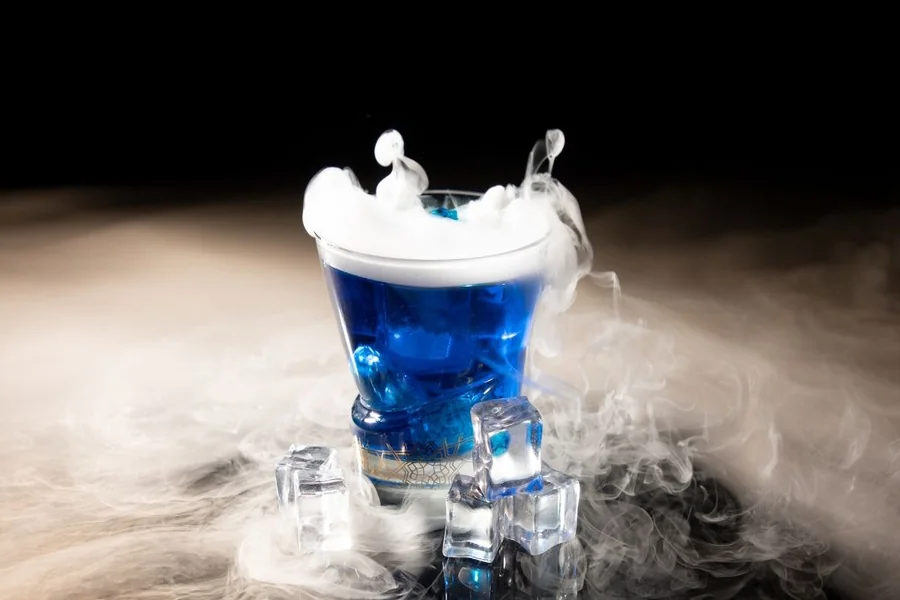
The smoking cocktail has quietly become a fixture on upscale menus. You order something with a dramatic name, and it arrives trailing a low fog that spills over the rim and pools on the table for a few seconds before vanishing. It photographs beautifully, which is most of the point.
But there’s real chemistry underneath the theater, and the restaurants doing it well know the difference between a gimmick and a technique.
What’s Actually Happening in the Glass
Dry ice is frozen carbon dioxide. It sits at roughly minus 109°F, and instead of melting into liquid the way water ice does, it sublimates, going straight from solid to gas.
Drop a small piece into a warm or room-temperature liquid and the CO2 rushes out fast. Because that gas is cold and dense, it hangs low rather than rising like steam. That’s the fog rolling over the rim.
The white cloud isn’t smoke. It’s water vapor. The cold gas chills the humid air around the glass below its dew point, and the moisture condenses into a visible mist. Nothing is burning, and nothing is on fire.
Why It’s Not Just for Looks
There’s a functional side too. The sublimating CO2 chills the drink quickly without diluting it, which is the opposite of what happens as regular ice melts. For a cocktail built around a delicate spirit, that matters. You get the cold without watering down the balance the bartender spent time getting right.
How Restaurants Are Using It
The application runs from subtle to full spectacle, and the sharper operators match the effect to the room.
The Tableside Moment
At the higher end, dry ice shows up in tableside presentations, where a server adds the piece at the table and the fog builds in front of the guest. It turns a drink into a small event. Bars have noticed this drives exactly the guest behavior they want: people film it, post it, and their friends walk in asking for the same thing.
Chilled Service and Displays
Beyond drinks, kitchens use dry ice under raw seafood towers and dessert plates, where a bed of fog reads as both fresh and theatrical. Some pastry teams build it into tableside finishes that release a puff of cold vapor when a dish is cracked or poured.
The Part Guests Don’t See: Safety and Sourcing
The theater only works if the handling behind it is disciplined. Dry ice is safe in a professional kitchen, but it demands respect. Staff need insulated gloves, because bare-skin contact causes a burn like frostbite within seconds.
It has to be stored in ventilated space, never a sealed freezer or a closed cooler that can build pressure. And a guest should never swallow a piece, so bar teams design presentations to keep the dry ice contained and gone before the drink is finished.
Food-Grade Only, and Fresh
Anything that touches food or drink has to use food-grade dry ice, and it has to be fresh. It sublimates continuously from the moment it’s produced, so a restaurant can’t stockpile it. Most kitchens running dry ice service reliably work with a regional supplier for industrial gas solutions like food-grade dry ice and CO2, delivered on a schedule that matches the service calendar rather than bought in bulk and left to disappear in a back-of-house freezer.
Adchem Gas, for one, supplies food-grade dry ice in rice and pellet form to hospitality clients across California, sized by the pound or by the tote depending on how much a kitchen actually goes through. The U.S. Food and Drug Administration sets the expectation that carbon dioxide in contact with food and drink meets food-grade standards, which is a good reason to buy from a proper gas supplier rather than a general retail source.
Substance Under the Spectacle
The reason the smoking cocktail has outlasted most menu trends is that it does two jobs at once. It chills without diluting, and it creates a moment guests want to share.